Data Marketing
How to grow an application from scratch using data
The mobile application ecosystem is currently one of the most competitive environments in the market. According to Statista, Google Play indexes around 90,000 new applications every month. Growing an application in a sustainable and efficient manner requires aligning multiple variables, and a data-driven digital marketing strategy is essential to be carried out in synergy with the brand's direction and in close collaboration with the customer.
The Data-First Approach
Accumulating initial data is a fundamental step in the process of developing an effective digital marketing strategy, especially for a new and innovative product seeking its place in the market. This stage involves collecting and analyzing relevant data, understanding market determinants, predominant consumer patterns, and customer needs. The data involved in this stage comes from various sources, such as market research, internal surveys, demographic analyses, statistics, direct online presence analysis, and more.
a). A Digitally Smart Client - Data-Driven Business
Digitally smart brands that use data to define and optimize the product they bring to the market are the ideal clients for a data-driven marketing agency. These brands already have a certain degree of digital maturity and understand the role of data in marketing strategy and product/service evolution. Communication with marketing, customer service, or even product development departments generates all the data that underpin the development of the strategy.
b). Competition and Best Practice Examples
Analyzing the competition involves several specific aspects related to the differentiators of the main direct competitors of the product and how competitor brands are formulated:
- Detailed analysis of competitive products - presentation, user experience, strengths.
- How competitor brands communicate with their target audience - wording, expressions, preferred channels.
- The main benefits they emphasize in their communication.
- The main directions of their marketing strategy - seasonality in communication, specific activations, and campaigns.
- The advantages and deficiencies that customers perceive in their interactions with the brand on social media or other channels, reviews, etc.
Translating the Brand into the Digital Realm
Aligning brand dimensions - voice tone, personality, visual identity, social identity - with the digital marketing strategy is crucial for creating a coherent and impactful online brand presence.
Some starting points for connecting important aspects to digital marketing efforts include:
Tone of voice and persona - copywriting and content writing
The brand's voice tone should be consistent across all digital marketing channels, including website content, social media posts, blog content, and email marketing campaigns.
Example:
If the brand's personality is friendly and approachable, the tone of voice should reflect this by using a conversational language, addressing the audience directly, and avoiding jargon or complex terminology. The voice must be defined in a way that aligns with the brand's values and conveys the values with which the brand associates itself.
The brand's personality is built based on specific characteristics of the target audience:
- Preferences and trends they adhere to.
- Mapping of their main motivations.
- Identifying pain points and dissatisfactions.
The expression of the brand's identity in marketing must remain true to these guiding principles while also enriching them. A well-crafted brand leaves room for continuous evolution and optimization.
The content of digital marketing campaigns should be continuously adapted to reflect the perceived personality of the brand, accommodating changes such as new product features, offers, etc. Messages, visual elements, and the overall brand experience are either directly communicated or transparently conveyed through details and mentions.
Visual identity - digital design
Consistency in visual elements is essential for the brand's impact, recognizability, and projected identity in the market.
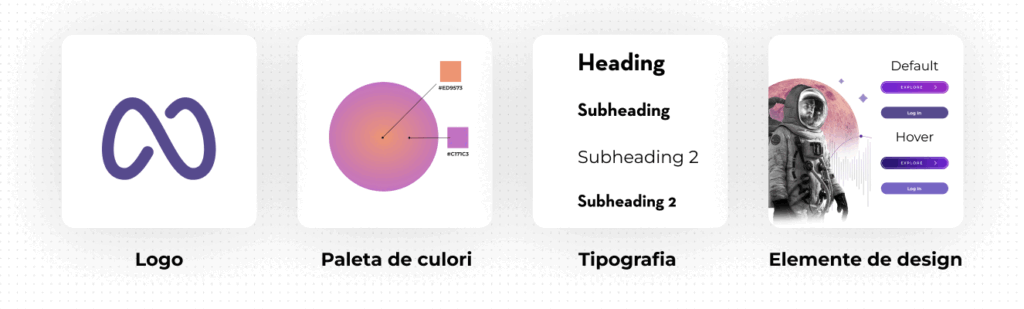
One of the most crucial pillars of a digital strategy is the implementation of the brand's visual identity, which includes:
- Logo
- Color palette
- Typography
- Design elements
The visual content, including images, videos, and infographics, should align with the brand's personality and values.
Social identity - social media
The social identity of the brand encompasses its presence and involvement on social media platforms. The digital marketing strategy relies on opportunities that exclusively come from the social media realm:
- Communicating the brand's values
- Engaging with the target audience
- Building a community
This can be achieved through sharing user-generated content, promoting sustainability initiatives, and responding to comments and messages in an authentic and timely manner. Social media content should align with the brand's tone of voice, personality, and visual identity, creating a consistent brand experience across all platforms.
By aligning these brand dimensions with the digital marketing strategy, the brand can create a strong and cohesive online presence that resonates with the market and sets the right foundation for generating loyalty.
Exposure vs. App Downloads
One of the essential stages in the marketing strategy involves finding the balance between investing in channels that generate awareness and those that produce conversions. This means dividing the budget between media channels that present the application to the target audience, highlighting its benefits, brand identity, attractiveness, novelty, etc., and performance marketing channels, which encourage users to download and use the application.
The Data Revolt Performance Marketing team has put together a very conclusive material about the strategic considerations that need to be taken into account when dividing between awareness vs. performance.
Full-Funnel Framework
Defining the customer journey or activation path of the application starts with identifying key moments in which the user is positioned concerning the decision to download and use the app. Each stage in the funnel must be accompanied by its own marketing actions.
Awareness
This is the first stage where users become aware of the application and are curious about its features and capabilities. In this stage, marketing campaigns focus on brand attractiveness and the overall value proposition, highlighting differentiators and aspects that appeal to potential early adopters.
Consideration
At this stage, users contemplate using the application. The emphasis should be on direct benefits and specific details about the service or product, discounts, or other advantages that prompt the decision.
Decision
During this stage, users decide to try the application and proceed to download it from app stores. Marketing efforts should concentrate on providing concrete information about how to use the app, activation details, or features that may not be immediately obvious. Depending on the nature of the application, tactical communications may be necessary to address specific pain points in the app usage process.

App Store Optimization (ASO)
App Store Optimization (ASO) is a crucial aspect of how app aggregators like Google Play and Apple App Store work. It involves actions to increase the app's visibility in app stores, leading to more organic downloads and higher conversion rates.
ASO has two major components:
a) Keyword optimization: Researching, analyzing, and selecting the best keywords to include in the app's title, subtitles, keyword field, and general description.
b) Conversion rates and optimization: Factors that impact organic impressions in the app store, including impressions from search and impressions from navigation.
Takeaways
The way an application becomes known and used in an extremely competitive market depends on a combination of factors and necessary steps. The common thread connecting all these steps is access to data. The marketing strategy must start with a careful analysis of the available market data, so that you can evolve in parallel with the insights that real-time data provides regarding the level of adoption and the application's evolution in terms of usage.
Extra resources:
We ve talked about how we approached the marketing strategy in the case of YOXO - a mobile subscription in the form of an app - for iQads.
If you need help promoting your mobile application or want to know more details, get in touch with us at hello@datarevolt.agency.
-----